
科研进展
【文献导读】需要长期静脉—静脉体外膜氧合治疗急性呼吸窘迫综合征的患病率和生存率:一项对体外生命支持组织登记数据的分析
文章来源:IE-learning IElearning急危重发布时间:2024-06-21 11:49
Prevalence and Survival of Prolonged Venovenous Extracorporeal Membrane Oxygenation for Acute Respiratory Distress Syndrome: An Analysis of the Extracorporeal Life Support Organization Registry
需要长期静脉-静脉体外膜氧合治疗急性呼吸窘迫综合征的患病率和生存率:一项对体外生命支持组织登记数据的分析
文章来源:DOI: 10.1097/CCM.0000000000006200
翻译:毕怡青,IE-learning翻译团队、中国心脏骤停与复苏研究联盟
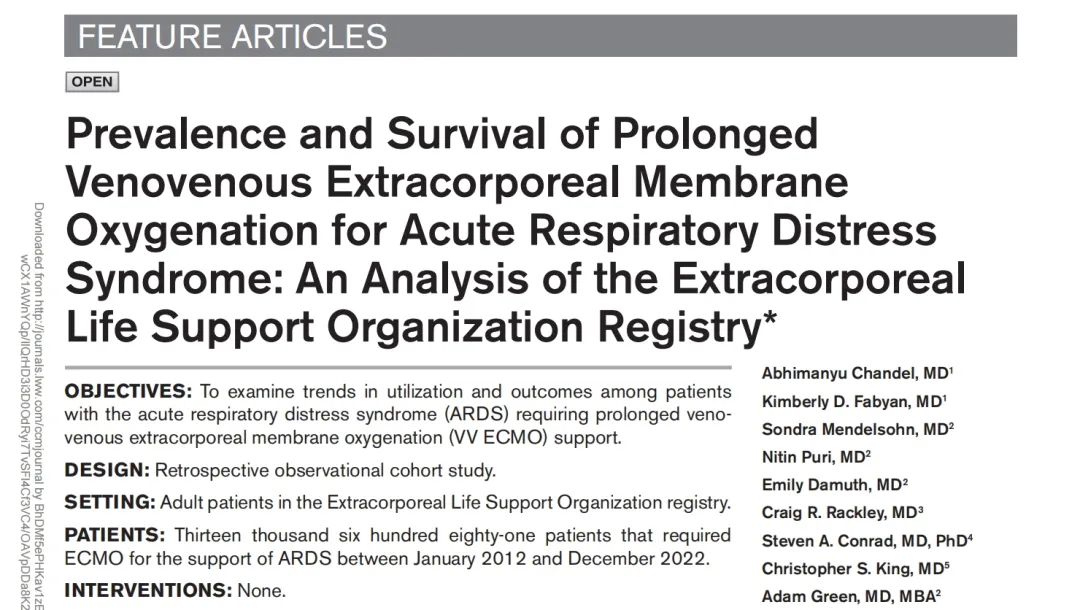
To examine trends in utilization and outcomes among patients with the acute respiratory distress syndrome (ARDS) requiring prolonged venovenous extracorporeal membrane oxygenation (VV ECMO) support.
研究目的
研究目的
研究需要长时间静脉-静脉体外膜氧合(VV ECMO)支持的急性呼吸窘迫综合征(ARDS)患者的使用趋势和结果。
Retrospective observational cohort study.
回顾性观察队列研究。
Adult patients in the Extracorporeal Life Support Organization registry.
在体外生命支持组织登记的成年患者。
Thirteen thousand six hundred eighty-one patients that required ECMO for the support of ARDS between January 2012 and December 2022.
2012年1月至2022年12月期间,13681名需要ECMO支持的ARDS患者。
Interventions
None.
无。
Mortality while supported with VV ECMO and survival to hospital discharge based on ECMO duration were examined utilizing multivariable logistic regression. Among the 13,681 patients supported with VV ECMO, 4,040 (29.5%) were supported for greater than or equal to 21 days and 975 (7.1%) for greater than or equal to 50 days. Patients supported with prolonged VV ECMO were less likely to be discharged alive from the hospital compared with those with short duration of support (46.5% vs. 59.7%; p < 0.001). However, among patients supported with VV ECMO greater than or equal to 21 days, duration of extracorporeal life support was not significantly associated with mortality (odds ratio [OR], 0.99; 95% CI, 0.98–1.01; p = 0.87 and adjusted OR, 0.99; 95% CI, 0.97–1.02; p = 0.48). Even in those supported with VV ECMO for at least 120 days (n = 113), 52 (46.0%) of these patients were
使用多变量逻辑回归分析了 VV ECMO 支持下的死亡率和基于 ECMO 持续时间的出院生存率。在VV ECMO支持的13,681例患者中,4,040例(29.5%)支持大于或等于21天,975例(7.1%)支持大于或等于50天。与支持时间较短的患者相比,长期VV ECMO支持的患者生存出院的可能性较小(46.5% vs. 59.7%; p < 0.001)。然而,在支持大于或等于 21 天的 VV ECMO 的患者中,体外生命支持的持续时间与死亡率无显著相关性(比值比[OR], 0.99; 95% CI, 0.98-1.01; p = 0.87,调整后的OR, 0.99; 95% CI,0.97–1.02; p = 0.48)。甚至在VV ECMO支持至少120天(n=113)的患者中,有52例(46.0%)最终存活出院。
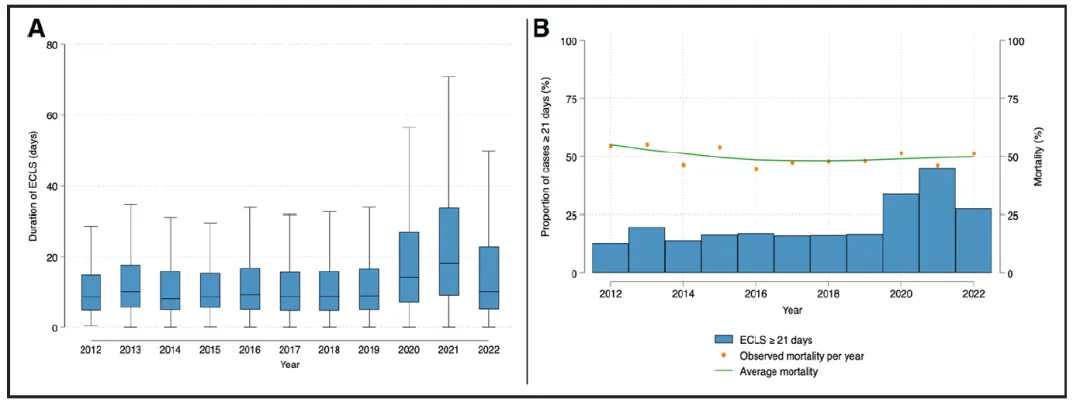
Figure 1. Venovenous extracorporeal membrane oxygenation (VV ECMO) duration and mortality. A, Box plot of VV ECMO duration based on year. B, Observed rate of discontinuation of VV ECMO for death or anticipated poor prognosis (circles), averaged rate (line), and proportion of prolonged VV ECMO (bar graph). ECLS = extracorporeal life support.
图1. 静脉-静脉体外膜氧合(VV ECMO)持续时间和死亡率。
A:基于年份的VV ECMO持续时间箱形图。B:因死亡或预期预后不良而停止VV ECMO的比率(圆点),平均率(线)和延长VV ECMO的比例(柱状图)。ECLS=体外生命维持系统。
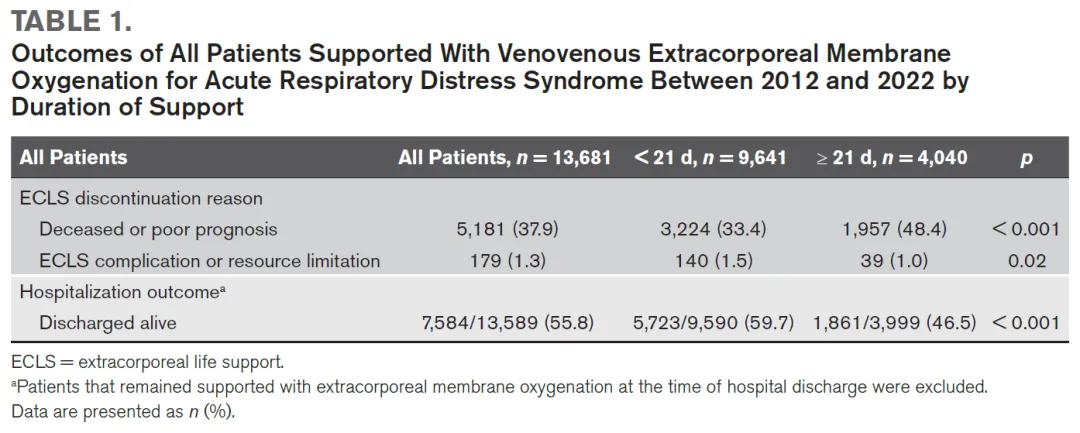
表1. 2012 年至 2022 年间接受静脉-静脉体外膜氧合治疗急性呼吸窘迫综合征的所有患者的结局(按支持持续时间划分)。
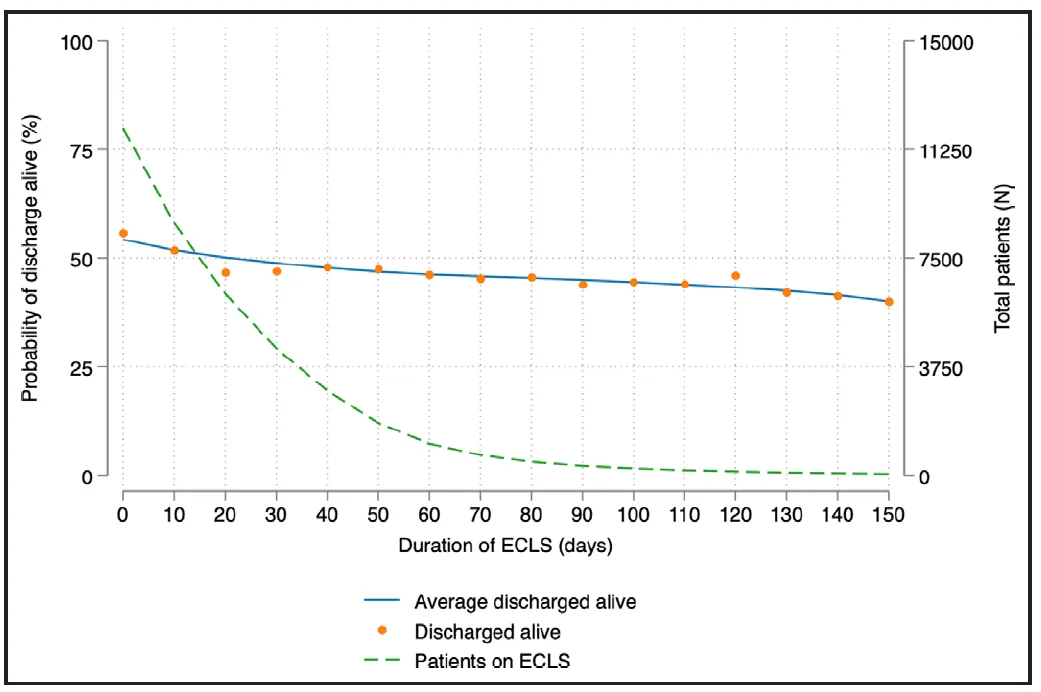
Figure 2. Observed probabilities of discharge alive (circles) for a patient based on duration of extracorporeal life support (ECLS), average probabilities (solid line), and total number of patients that remain on ECLS at specific time points (dashed line).
图2. 根据体外生命支持(ECLS)持续时间、平均概率(实线)和特定时间点继续使用体外生命支持的患者总数(虚线),观察到患者存活出院的概率(圆点)。
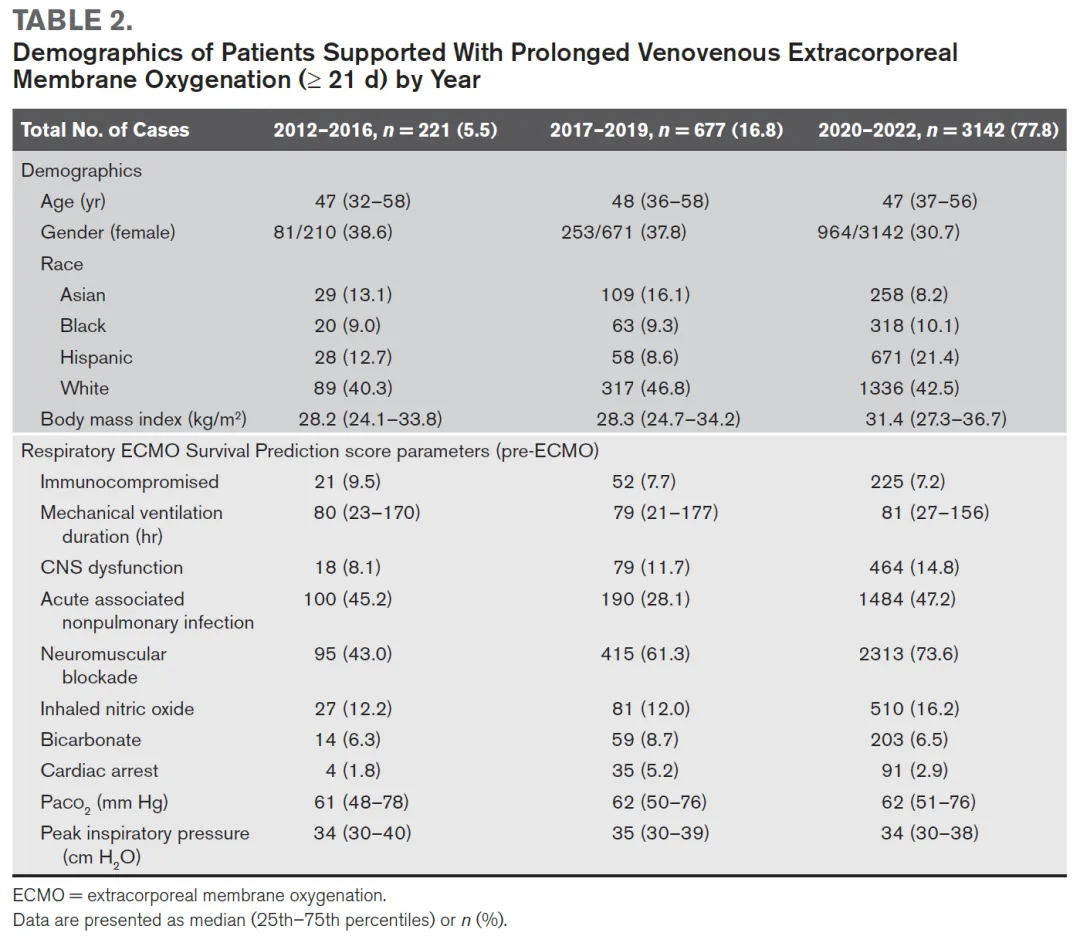
表2. 长期静脉-静脉体外膜氧合支持(≥21天)患者的人口统计学资料
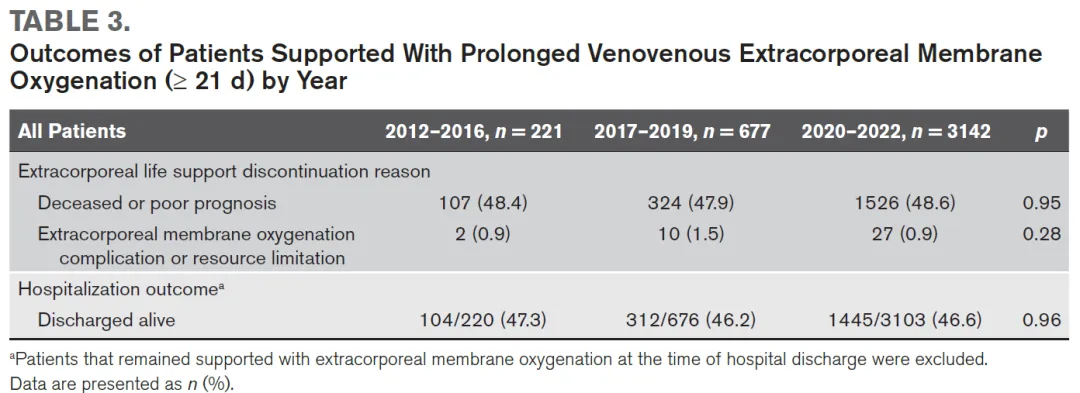
表3.长期静脉-静脉体外膜氧合支持(≥21天)患者的预后(按年份)
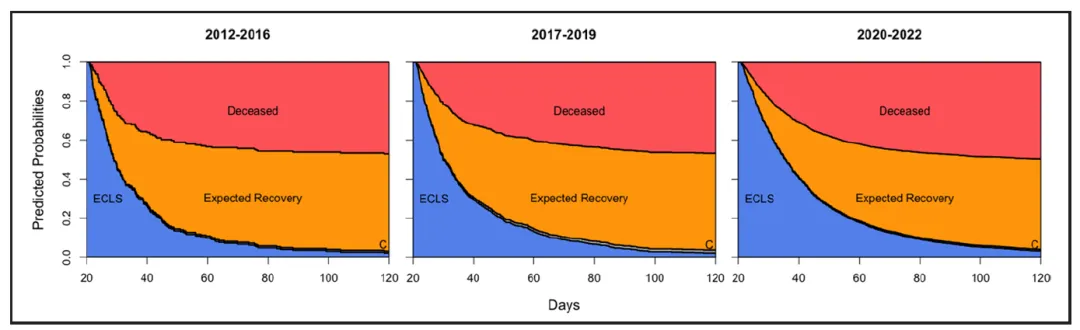
Figure 3. Stacked probability plots based on time period reflecting time from initiation of venovenous extracorporeal membrane oxygenation (VV ECMO) to discontinuation for death or expected poor prognosis, expected recovery, or VV ECMO complication or resource limitation. The proportion of patients discontinued from VV ECMO for complication or resource limitation is delineated in the rightmost column of the figure. ECLS = extracorporeal life support.
图3. 基于时间段的叠加概率图,反映了静脉-静脉体外膜氧合(VV ECMO)从开始到因死亡或预期预后不良、预期恢复或 VV ECMO 并发症或资源限制而终止的时间。因并发症或资源受限而停用 VV ECMO 的患者比例见图最右列。ECLS=体外生命支持。
Conclusions
Prolonged VV ECMO support of ARDS has increased and accounts for a substantial portion of cases. Among patients that survive for greater than or equal to 21 days while receiving VV ECMO support, duration is not predictive of survival to hospital discharge and clinical recovery may occur even after very prolonged VV ECMO support.
ARDS的长期VV ECMO支持有所增加,并占很大一部分比例。在接受 VV ECMO 支持大于或等于21天的存活患者中,支持时间并不能预测出院后的生存率,即使在非常长时间的 VV ECMO 支持后也可能出现临床恢复。
编辑丨国 康
审核丨毕怡青 江涛 徐峰
中国心脏骤停与复苏研究联盟
IE-Learning急危重症学习平台
原创声明:文章权限归原作者所有,如需转载请联系我平台。
IE-Learning急危重症学习平台
原创声明:文章权限归原作者所有,如需转载请联系我平台。